Monday, October 15, 2007

Re: First Thing's First

In regards to the comment I received on the test post I did:

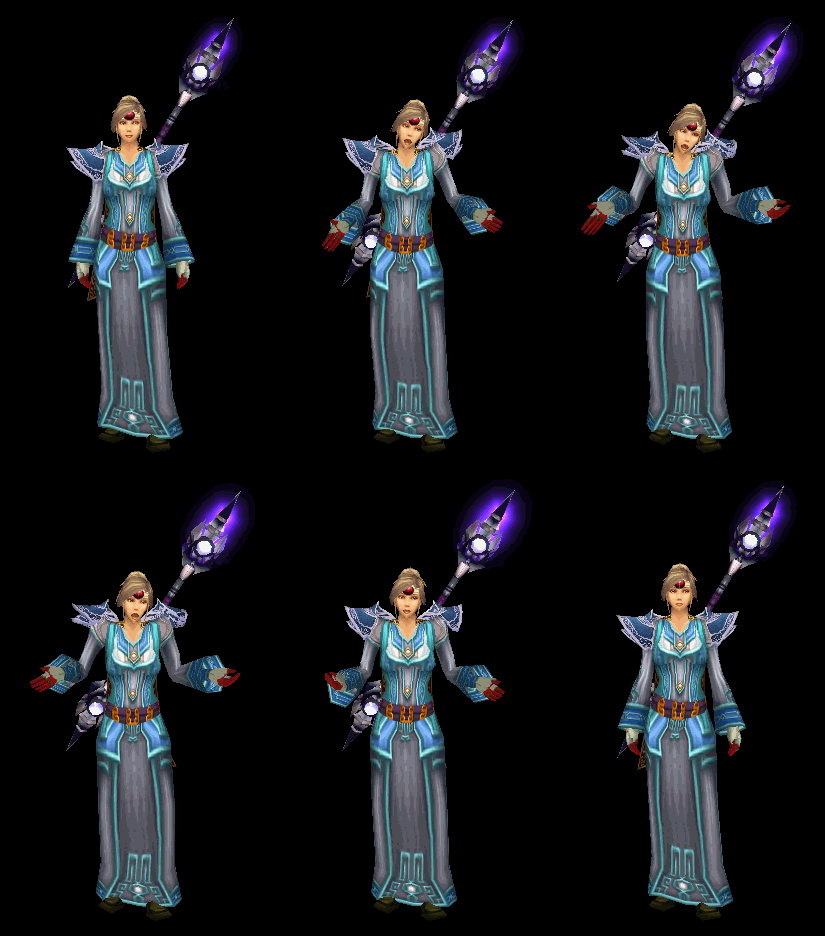
This is a .gif exported from WoWModelViewer, which allows one to view the 3D models from World of Warcraft installed on a computer (ie, one has to own the game to be able to use the stand-alone free program created by fans). I'm pretty sure I messed around with its size in Adobe ImageReady CS. As far as I recall, I wanted to test Blogger's image display and so I chose a rather fussy format, the animated GIF.

There's not much else to it, except that the GIF format uses an indexed color mode that can only display 256 colors (including transparency) in any given frame. The newer PNG format is much better at displaying transparency and a wider variety of colors, but it can't show animation.

I really wish all games had such a large base of fans that include programmers capable of producing model viewers! Then I could have an animation of Alice bouncing her croquet ball off her mallet and onto her boot. Not that it's totally irrelevant to class or anything.

Wednesday, October 3, 2007

Musing Again on Memory/Imaginary

After talking with Dierdre, I was thrilled to learn she's not opposed to using stock photography or generally photos/images not taken by myself! Yes, the days of anal-retentive art teachers are over! (Pardon me.)

With this new information in mind, a vast quantity of possibilities have been opened up to what I can explore. Now I'm leaning toward combining ideas of time and the supernatural, which should be an exploration into what constitutes reality and what the nature of time is (linear vs. simultaneity theories). If possible, I will snag that old book from home to examine Diane Stein's opinion on supernatural phenomena relating to time.

Perhaps I'll put my own composites side to side with "real" (supposed) images of the supernatural that have similar content. If possible I'd love to have 7 different images, alluding to numerology and the magical properties of its value.

Saturday, September 29, 2007

Musing: Memory and Imaginary

I had several ideas for the project, all of which I did not know how to accomplish without a tripod or models and sets. Most of these ideas only spanned for one image and did not always have common themes running through each image/idea.

The best damn bear on the planetThe first was questioning whether it is possible to reproduce mental memory in a photograph. One of my first memories is of losing my childhood teddy bear and later receiving a new one from my mother. The latter is a distorted image, as I do not recall exactly what my old room looked like (it occurred at the age of approx. 4). Most of the room would have to be blurred out, my mother or the representation of my mother would need longer hair than she has now, as well as an old down coat. The circumstances do not really permit me to address this issue.

'Ectoplasm'
Another idea I recently came across was how we interpret and remember the supernatural. However, there are so many photographs of supposed real/fake ghosts, spirits, orbs, ectoplasm, and lines of light that I think it would be impossible to garner deep meaning from images. The paradox here is that even if I implied these images could be 'real,' I would need to essentially create the supernatural element in a mundane photo. How could I capture the memory of supernatural in a manipulated photo (likewise for all those claimed 'authentic' photos out there)? It's a good question but I'm not sure of the implications. Furthermore, the entire project would be more effective if it were done in motion media instead of still photography.

The idea I have now questions the reality of our photography, which I came upon by looking through all of the photos stored on my external hard drive. I noticed I had many photos that included clocks but they were not the focus of the image. At the time I was unaware of what the clockfaces actually read, and there is absolutely no way I would remember the 'exact time' (our humanly construction) during the shooting of the photos. With these bits of data/captured light, however, anyone can see when in our timeline it was taken.
Obviously some cameras superimpose the date onto each photo, but that is more of an internal process to the mechanism than a reflection of the outside world.
My understanding of this is that we as humans remember things spatially, physically, or sensationally. Photographing clocks or taking photos that include clocks, on the other hand, places the image temporally, creating a new part of the memory -- enhancing and manipulating the memory of the event in the mind.

Preferably, there would be twelve of these clock images. The problem is I don't have access to many more clocks than Mill's campanile and my own watch or alarm clock. Some of the images really wouldn't fit because all the photos I already have are of analog clockfaces.
Wednesday, September 19, 2007

First Project: Scanning

Click any image to view larger size.

Source: Color positive, reflective (photo)
Scan Resolution: 360 ppi, approx. 6x10
Issues: Needed spot healing due to dust. Looks washed out on certain monitors. Used Curves (with 'lockdown' strategy) to lighten darkest areas because the scan was too contrasted even with normal color settings on scanning software.


Source: Color positive, reflective (photo)
Scan Resolution: 360 ppi, approx. 6x10
Issues: Needed spot healing and cloning/stamping due to MAJOR dust and particles. Used Color Balance to lessen the warmth of the overall image (midtones only).


Source: B&W negative, transparent (Dierdre's)
Scan Resolution: 360 ppi, approx. 6x10
Issues: Scanned at 8bit black and white. Needed spot healing due to dust. Used Levels and Brightness/Contrast to deepen blacks; used masks on certain areas, such as the sky, to opt out of those adjustment layers because of loss of information.

Note on Macs, Browsers, and USB drives

Hey all in Digital Imaging, I thought I should leave a message to
everyone in the class as a warning/reminder.

I stayed a little longer than usual to finish up my projects. When I
went to open Firefox so I could upload my pictures to Blogger, the
entire computer froze up (I dared to use Firefox because Safari is
lacking in some features that Blogger uses, eg the rich text editor). I
had to restart the entire machine, and I suppose I pulled my USB drive
out too early. This wiped the entire partition table. For those who
don't know what that means, it's like having all the names and pointers
to your files on your hard drive be destroyed, leaving it with raw and
fragmented data.

I bought recovery software, but it was unable to retrieve complete
files of everything. What I lost was more than .tiffs for this class. I
had personal works on there, as well as an 11 page essay for my
Anthropology class. Luckily, I had earlier drafts in my email so I was
able to re-finish it.

Heed Deirdre's original advice:
  1. Don't pull out the flash drive until it's ejected and gone from the desktop. How to resolve this when the computer is completely locked up, I don't know.
  2. Stay away from Firefox. Sometimes even Safari freezes up.
  3. NEVER rely on your flash drive as a primary storage device! Always make back-ups. Unfortunately our Mills servers only hold 20MB per student, not nearly enough for our class work. Save stuff to your home laptop/computer, save it to your work Mac in Prieto, or if you're lucky, upload it to a server with FTP and storage.

These will save you hell, I swear. I bet you're better than I am and do
all that anyway! :)

See you Monday,
Julie A.

Monday, September 17, 2007

Test Upload

Test upload from Mac. Click image for full size.

Wednesday, August 29, 2007

First Thing's First

Set up for Digital Imaging 041, a Mills College class. We'll see how this goes, especially on the school Macs.